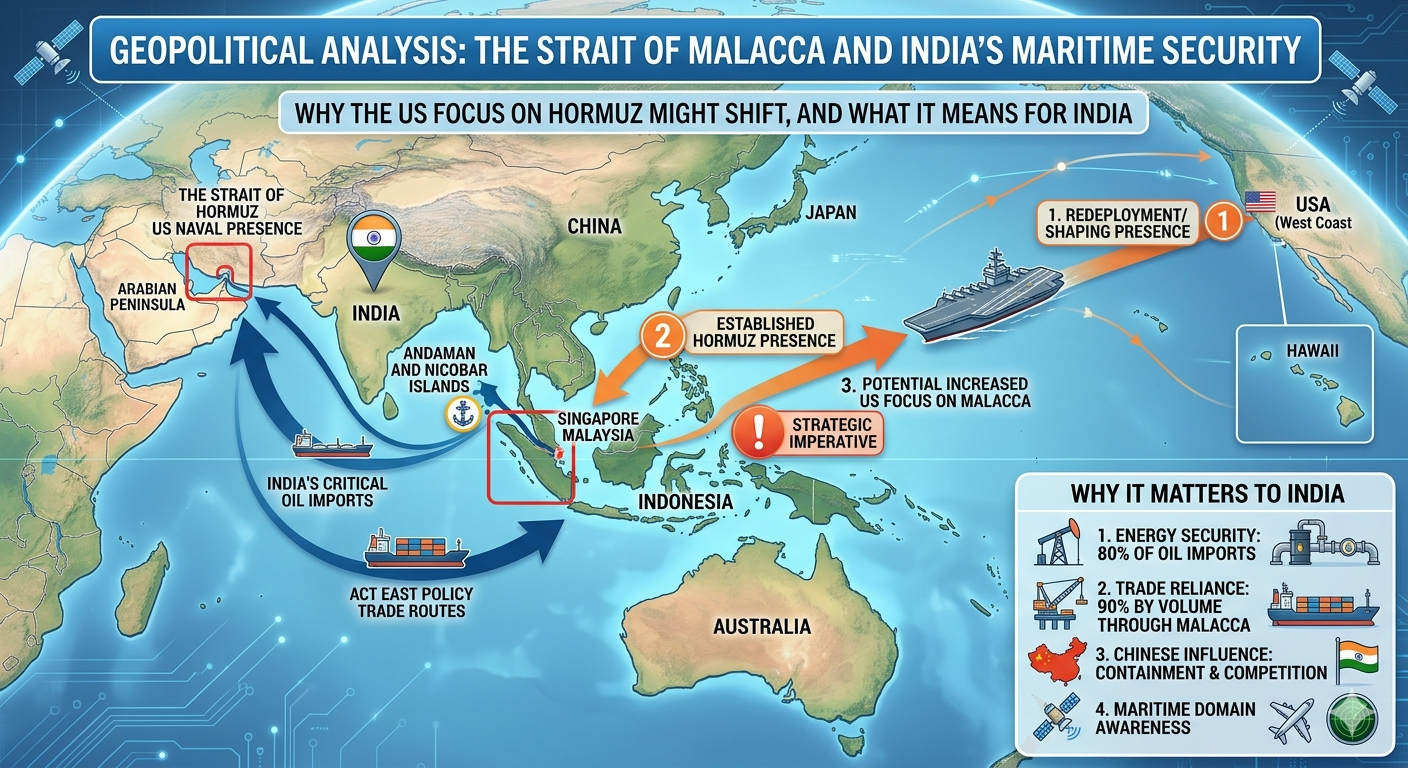
As the Iran crisis chokes the Persian Gulf, Washington’s gaze is shifting eastward toward another vital maritime artery — with profound consequences for New Delhi.
|
40% Global trade through Malacca annually |
$3.5T Annual goods moved via Malacca |
80% China’s oil imports via Malacca |
23M Barrels of oil per day through Malacca |
What Is the Strait of Malacca?
The Strait of Malacca is a narrow waterway stretching approximately 890 kilometres between the Malay Peninsula and the Indonesian island of Sumatra. At its narrowest point near Singapore, it measures just 2.8 kilometres across — a geographic bottleneck through which an extraordinary volume of the world’s commerce flows daily. It connects the Indian Ocean to the South China Sea and the Pacific Ocean, making it one of the most strategically critical maritime passages on the planet.
Unlike the Strait of Hormuz, which is primarily an energy corridor, Malacca is a full-spectrum trade artery. Crude oil and liquefied natural gas flow eastward toward China, Japan, South Korea, and India. Semiconductors, electronics, automobiles, and finished goods flow westward from Asia’s manufacturing hubs. Raw materials cycle through to feed factories across the region. The strait does not represent a single supply chain — it is where most of the world’s supply chains converge simultaneously.
“Hit Hormuz, and you generate an energy shock. Hit Malacca, and you do something the global economy hasn’t had to absorb — because nothing like it has happened in the modern era.”
Why Is the US Now Eyeing the Strait?
On April 14, 2026, the United States and Indonesia signed a landmark Defence Cooperation Agreement. While the agreement was framed in broad terms of regional security and bilateral partnership, international analysts and geopolitical observers were quick to interpret its deeper significance: Washington’s strategic focus appears to be expanding from the Strait of Hormuz toward the Strait of Malacca.
The timing is far from coincidental. With the Hormuz crisis demanding enormous military and diplomatic resources, the US Navy has been redirecting assets through the Malacca Strait to support operations in the Persian Gulf — including routing an amphibious ready group through the strait earlier this year. This movement has exposed a critical strategic vulnerability: every naval asset deployed toward Hormuz is an asset no longer positioned in the waters that matter most for a potential China contingency.
The Malacca Strait sits at the intersection of Indonesian, Malaysian, and Singaporean sovereign territories, making coordinated control far more complex and politically sensitive than Hormuz. Yet this complexity is precisely why the US is investing in diplomatic groundwork now, securing partner access and basing agreements before any crisis escalates.
The China Factor: The “Malacca Dilemma”
To understand why the Strait of Malacca is so geopolitically explosive, one must understand what strategists have long called the “Malacca Dilemma.” Approximately 80 percent of China’s oil imports travel through this narrow waterway. In any blockade scenario — enforced by the US, India, or a coalition — China’s economy would slow dramatically and its military logistics would begin to degrade within weeks.
This is the core strategic vulnerability that Beijing has spent decades trying to address, investing in overland pipeline routes through Central Asia and Myanmar, constructing deep-water ports in Pakistan and Sri Lanka under its Belt and Road Initiative, and maintaining a permanent naval presence in the Indian Ocean. Yet despite all these efforts, China’s dependence on the Malacca Strait has not fundamentally changed. The economics of maritime shipping remain far too efficient to replace.
The Malacca Strait therefore functions as the most powerful leverage point the US and its allies possess over China in any major conflict. Closing or credibly threatening Malacca does not require winning every military engagement — disrupting the supply chain alone does the strategic work while the opposing forces are occupied elsewhere.
Why This Matters Critically to India
The Andaman and Nicobar Advantage
India’s strategic position in any Malacca-related scenario is uniquely powerful. India’s Andaman and Nicobar Islands are located near the western entry point of the Strait of Malacca — effectively giving New Delhi a front-row seat, and potentially a controlling hand, over one of the world’s most critical waterways. Analysts have described this geographic advantage as India’s “unsinkable aircraft carrier” in the eastern Indian Ocean.
The Andaman and Nicobar Command, India’s only tri-service theatre command, is stationed precisely at this strategic junction. As the US-Indonesia defence agreement takes shape and American strategic focus shifts toward the Indo-Pacific, India’s role as a key partner — and stakeholder — in Malacca’s security architecture becomes increasingly central.
India’s Own Trade and Energy Dependencies
But India’s interest in the Strait of Malacca is not purely strategic — it is also deeply economic. A significant portion of India’s trade with East Asia, Southeast Asia, and the broader Pacific passes through the strait. Indian exports of pharmaceuticals, textiles, and engineering goods travel east through Malacca. Critical imports including electronics, machinery, and raw materials travel west through the same passage.
India also imports crude oil from Southeast Asian and Pacific suppliers that route through Malacca, making the strait a vital energy corridor for New Delhi as well as Beijing. Any prolonged disruption — whether through conflict, piracy, or deliberate blockade — would have immediate consequences for Indian industry and inflation.
India’s Andaman and Nicobar Islands sit at the western entrance of the Strait of Malacca, positioning New Delhi as a crucial stakeholder in any maritime security arrangement in the region. India is one of only a handful of nations with the geographic and military capacity to project meaningful power at this chokepoint.
The Piracy Problem
Compounding the geopolitical tensions is a sharp rise in maritime piracy in the Malacca region. The strait recorded 108 piracy incidents in 2025 — a 19-year high — straining the security arrangements that have kept commercial shipping relatively safe for the past two decades. As US naval assets are drawn toward the Hormuz conflict, the policing gap in Malacca has widened, creating an opening that criminal networks and potentially state actors could exploit.
Global Trade Consequences: Hormuz vs. Malacca
It is worth drawing a direct comparison between the two straits to appreciate the scale of what is at stake. The Strait of Hormuz carries approximately 20 to 21 million barrels of oil per day and represents around 20 percent of the world’s seaborne crude oil trade. Its current blockade has caused severe energy price shocks across global markets.
The Strait of Malacca, however, carries an estimated 23 million barrels of oil per day alongside $3.5 trillion in annual goods — representing roughly 40 percent of all global seaborne trade. A disruption to Malacca would not produce a price shock but a systemic collapse: supply chains across electronics, automotive, pharmaceutical, food, and consumer goods sectors would simultaneously fail. The global economy has absorbed versions of an energy shock before. It has never had to absorb a full Malacca disruption in the modern era.
What Should India Do?
India finds itself at a rare strategic inflection point. The convergence of the Hormuz crisis, the US pivot toward Malacca, the US-Indonesia defence agreement, and China’s structural vulnerability creates a window of opportunity for New Delhi to assert itself as an indispensable maritime security partner in the Indo-Pacific.
Experts suggest India should accelerate infrastructure development at the Andaman and Nicobar Command, including expanded naval basing, surveillance capabilities, and airstrip capacity. New Delhi should also engage actively in multi-lateral maritime security dialogues with the US, Indonesia, Singapore, Malaysia, and Australia to shape the emerging security architecture around Malacca on India’s terms — rather than simply reacting to agreements made without Indian input.
At the same time, India must tread carefully. Any perception that New Delhi is becoming a junior partner in an American strategy designed primarily to contain China risks complicating India’s carefully maintained policy of strategic autonomy and its own significant economic relationships with Beijing.
🔍 Conclusion: The World’s Next Flashpoint
The Strait of Hormuz has dominated global headlines since February 2026. But the Strait of Malacca may prove to be the defining maritime flashpoint of the decade ahead. As the United States expands its strategic footprint in Southeast Asia through the newly signed US-Indonesia Defence Cooperation Agreement, the geopolitical chessboard is shifting — and India, with its unique geographic advantage in the Andaman and Nicobar Islands, stands at the centre of the game.
For India, this is not merely a story about distant great-power competition. It is a story about trade, energy, economic security, and the future of the Indo-Pacific order. The decisions made in New Delhi, Washington, Jakarta, and Beijing over the coming months will determine whether the world’s most important trade corridor remains open — or becomes the next casualty of an era of accelerating geopolitical fracture.
Leave a Reply